SolarRates · Guide
Choosing the Best Energy Plan for Your Solar Battery
Standard comparison sites assume you're a normal household. Battery owners aren't. Here's what actually matters, explained plainly.
Why standard comparison sites get it wrong
Most energy comparison tools are built around a simple model: you use X kWh per day, you pay Y cents per kWh, here's your annual bill. That works fine for a flat with no solar. For a battery household it's nearly useless.
Battery owners have almost no daytime grid consumption. Their peak usage is a few evening hours after the battery depletes — if it depletes at all. Their income comes from feed-in tariffs, VPP credits and strategic export timing. Standard comparison tools ignore all of it. The feed-in tariff field, if it exists at all, assumes you export uniformly all day at a flat rate. Nobody with a battery does that.
The result: battery owners are routinely on plans optimised for flat-consumption households. The wrong supply charge tier. No VPP credit. A standard FiT when a peak-window FiT would pay three times as much for the same export. Over a year that's often $300–600 left on the table — sometimes more.
The five things that determine your real cost
1. Daily supply charge
The fixed fee you pay regardless of how much electricity you use. Typically $1.20–$1.60/day, though some plans run higher. For a battery household with good solar, grid consumption on a clear day can be near zero. That makes the supply charge your single biggest unavoidable cost. A plan with a 10¢/kWh lower peak rate but $0.30/day higher supply charge may cost you more overall — run the numbers for your usage, not a generic household.
2. Peak vs off-peak rates
Time-of-use (TOU) plans charge significantly more during evening peak — typically 3–9pm, sometimes 4–8pm depending on the network and retailer. With a charged battery you can avoid drawing from the grid during this window entirely, making the peak rate almost irrelevant. The catch: if your battery runs out before peak ends, you're hit with the expensive rate on every kWh. Off-peak rates matter more than peak rates for most battery households — it's what you pay when the battery's flat and it's 10pm.
3. Feed-in tariff structure
Standard feed-in tariffs in SE Queensland have fallen to 3–6¢/kWh as of 2026 — close to worthless for managing your economics. The more interesting structure is a peak FiT window: a higher rate for exports during a specific time period. GloBird ZeroHero, for example, pays 15¢/kWh for the first 10kWh exported between 6–9pm. On a day where you export 8kWh in that window, that's $1.20 — versus $0.40 at a flat 5¢ rate. Same solar, same battery, three times the income. The window timing and daily cap matter enormously; a plan advertising "peak FiT" with a 2kWh cap is much less valuable than it looks.
4. Free charge windows
Some plans offer genuinely free grid electricity during a specific midday window — ZeroHero offers free power 11am–2pm. On a clear summer day your battery charges from solar and this doesn't matter. On a cloudy day in winter when solar alone won't fill a large battery, free grid power during those hours is a real benefit. Across a year of variable weather, a free charge window on a large battery can be worth $100–200 in avoided peak consumption. It's not a gimmick, but it's also not the headline feature — treat it as a meaningful bonus rather than the deciding factor.
5. VPP credits and conditions
Virtual power plant credits are typically a daily payment for keeping your grid draw below a threshold during a specified peak window. ZeroHero pays $1.00/day if you draw less than 0.06kWh from the grid over the 6–9pm window — that's extremely tight. A household that runs an air conditioner, oven or hot water system during that period will frequently fail the condition. A household with a large battery, good solar and low evening consumption can earn close to the full $365/year. The credit structure is the most variable and complex part of any VPP plan; always check the exact condition, not just the headline dollar figure.
The main plan structures available in 2026
Most energy plans for battery households fall into one of five categories. Understanding the structure helps you ask the right questions when comparing.
| Plan type | Best for | Watch out for |
|---|---|---|
| Flat rate + standard FiT | Simplicity. Predictable bill. Good if your battery rarely depletes. | Standard FiT is low. No incentive to optimise export timing. |
| Time-of-use (TOU) + FiT | Households confident their battery will always cover peak. Lower off-peak rates reduce overnight costs. | If your battery runs out before 9pm, peak rates are expensive. Off-peak rate matters more than it looks. |
| Controlled VPP Retailer dispatches your battery | Set-and-forget. Retailer manages dispatch, you earn credits. | You give up control of your battery. May conflict with your own usage needs. Check the contract carefully. |
| Self-managed VPP e.g. GloBird ZeroHero | Any battery brand. You control dispatch, earn credit for meeting a behaviour condition. | Condition can be hard to meet consistently. Requires understanding the credit rules before signing up. |
| Wholesale pass-through e.g. Amber Electric | Battery households with smart controllers that respond to spot prices automatically. | Bill varies significantly. Not suitable without automation or active management. Spot prices can spike. |
If you're in Queensland
Queensland has two major distribution networks: Energex (South East Queensland — Brisbane, Gold Coast, Sunshine Coast, Ipswich, Toowoomba) and Ergon Energy (regional Queensland — Wide Bay, Capricorn, Mackay, Townsville and north). Some plans are only available in one network area.
GloBird ZeroHero — the most-discussed plan in the community database — is currently available in Energex areas only. If you're in an Ergon zone you'll need to look at different options; the plan types table above still applies but the specific plans differ.
Queensland's feed-in tariff environment has changed significantly. The state government's minimum FiT has been removed, leaving it to retailers. Most are offering 3–6¢/kWh as of early 2026. This makes the peak FiT window structure significantly more valuable than a marginal improvement in standard FiT rate — 2¢ more on a standard FiT is almost nothing; 10¢ more during a 3-hour export window on a good solar day is meaningful money.
The ZeroHero $1/day credit maths: if you win the credit every day for a year, that's $365. Realistically, a household with a large battery and moderate evening load might win it 250–300 days. At 270 days that's $270/year — still a substantial benefit above any plan without a VPP credit. The question is always whether your setup can reliably meet the 0.06kWh grid-draw condition during the 6–9pm window.
Real rates from real battery owners
SolarRates is a community database of energy plan rates submitted by battery owners across Australia — not by retailers, not by affiliates, not by comparison platforms with a financial interest in what you click.
Filter by your postcode to see plans submitted from your network area. Each entry shows the actual rates, FiT structure, VPP credit conditions and supply charge — the things that matter for battery households, not the things that look good in a marketing table. Entries are flagged when the community thinks the numbers look off, and marked verified when multiple members have confirmed them.
If you're on a plan that isn't listed, submit your rates. It takes two minutes and it directly helps other battery owners in your area compare properly.
How it works — built and running today
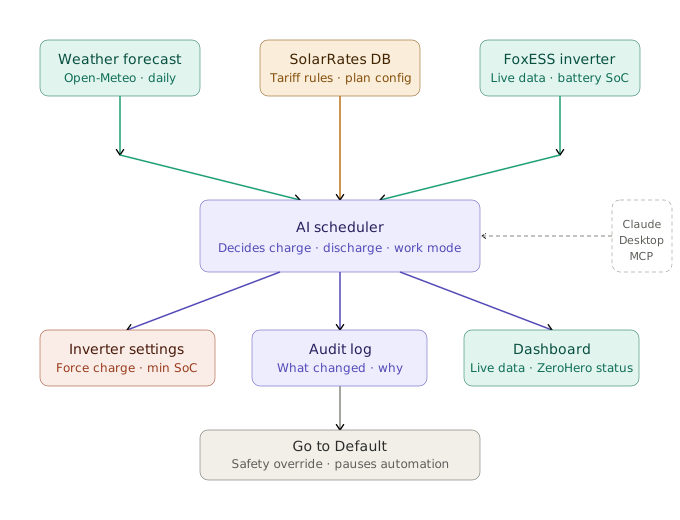
This isn't a concept. The system below is running right now on a FoxESS KH9.9 with 40kWh of Fox ESS battery storage on Stradbroke Island, Queensland. Every morning at 5am it checks the weather forecast, reads the current battery SoC, and decides whether to schedule force-charging during GloBird ZeroHero's free 11am–2pm window. Every decision is logged with a plain-English explanation. The Go to Default button restores safe settings instantly if anything looks wrong.
Interested in this for your system? We're working on making it available for other FoxESS owners. Get in touch →
Common questions
Is a VPP worth it for battery owners?
Depends on your battery size, usage pattern and how reliably you can meet the credit conditions. A 10–15kWh battery with a low-consumption evening household can usually meet the ZeroHero grid-draw limit. A smaller battery or a house with teenagers home in the evening might struggle. Run the numbers against your actual bill first.
Should I switch to Amber Electric?
Amber passes through wholesale spot prices — which means you can earn very well during price spikes but also pay a lot during demand events. It suits battery households with a smart controller that can respond to price signals automatically. Without automation, the bill variation is hard to manage. It's genuinely a good option if your setup supports it.
What's the best energy plan for solar and battery in QLD?
There's no universal answer — it depends on your daily usage, battery size, export volume and whether you're in the Energex or Ergon network. GloBird ZeroHero is well-regarded in Energex areas for its $1/day VPP credit and free charge window, but it only makes sense if your battery can reliably avoid grid draw during the 6–9pm window. Check the community rates database and compare against your actual bill figures.
Does my inverter or battery brand matter for VPP programs?
For some VPP programs, yes — some require specific brands (Tesla Powerwall for certain retailers, BYD or Sonnen for others). GloBird ZeroHero is brand-agnostic because you control your own battery behaviour; the retailer just measures your grid draw. Self-managed VPPs are generally more flexible.
How often do energy plan rates change?
Retailers can and do change rates, usually with 10–20 days notice. The community database reflects submitted rates at a point in time — always verify current rates directly with the retailer before switching. That's why we show submission dates and a verification status on each entry.
From the blog
Information current as of early 2026. Energy plan rates and conditions change — always verify directly with the retailer before switching. This guide contains no affiliate links and SolarRates earns nothing from plan recommendations.